
Students in Exile: A New Life and Academic Freedom in Vilnius
Jan 18, 2026
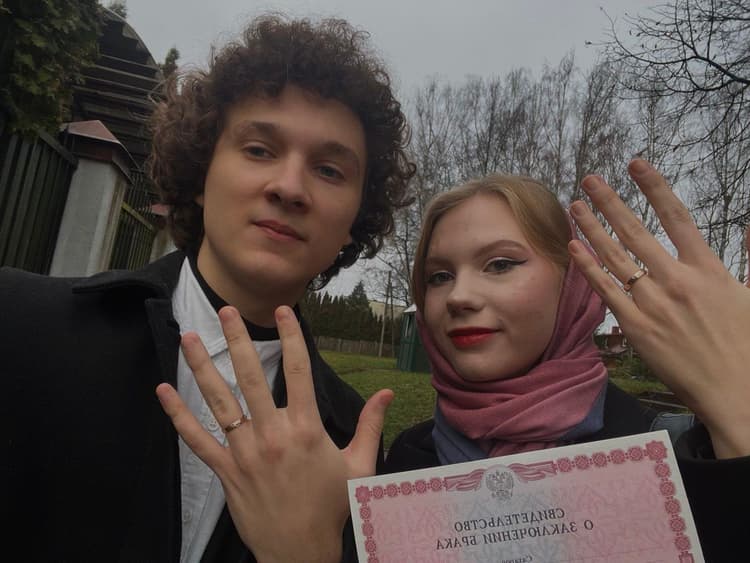
Artem Sakharov is an anti-war activist from Barnaul. Together with his wife Victoria, he is now studying at the European Humanities University (EHU) and continuing to build their future despite exile and financial hardship. In this interview, they share how pressure within Russian universities undermines academic freedom, why education became a lifeline for them, and what plans they are making for the future.
Can you briefly tell us about your life and academic path?
A: One could say that we — me, as an anti-war activist from Barnaul, and Vika, as the person with whom we went through much of this path together, because we were in a relationship at the time and are now already a family — are people who, because of our activism, because of the pressure exerted by the Putin regime, did not manage to stay in Russia and continue our education. Vika was in her third year of college, and I was in my first year of university, and under these conditions we were forced to leave for Lithuania, to Vilnius. Now we are second-year students at the European Humanities University.
And when you were initially applying in Barnaul, did you think about enrolling in another city or even abroad?
V: No, not really.
A: You didn’t. I was planning to apply to St. Petersburg — everything depended on my Unified State Exam results, and there weren’t exactly concrete plans, but there was hope. Probably everyone who lives in provincial cities in Russia has that kind of dream of leaving for St. Petersburg or Moscow. So yes, there were such dreams, but it was impossible to realize them, because it’s very hard to get a tuition-free place in cities like that — it’s very expensive to live there. So we enrolled in the simplest, most basic options. But at the same time, not the worst ones — for our city, they were decent.
In some of your interviews, you mentioned that other students in Barnaul filed malicious complaints against you. Could you tell us more about the atmosphere at the university, especially in terms of academic freedom?
A: People didn’t file complaints against Vika, because she wasn’t engaged in such high-profile activity; she mostly just took part with me in rallies and protests. Overall, there wasn’t any separate activism on Vika’s part, so things were calmer for her.
V: Well, I was summoned for meetings after a protest, invited to various conversations, and there were conversations with my academic advisor. But overall, classmates and other people didn’t really file complaints against me.
A: For me, it was different — the entire university knew that I had organized something, that I had been detained, fined, arrested. People wrote a lot about it on social media, so it was always part of my academic life. My first action was actually back in school, and the next two were already at university. And at school everything was fine, without complaints, but at university the environment was more diverse. I was studying political science; there were four cohorts of political science students, and naturally you could find people with all kinds of views there: communists, Z-patriots, liberals, nationalists — everyone, absolutely everyone. Accordingly, among those Z-patriots there were very active ones who were building their careers by participating in MGER, the Young Guard of United Russia (editor’s note: “United Russia” is Russia’s ruling party). They took part in all pro-government actions, traveled to Donbas, systematically built their careers in Russia, and, as I understand it, were very ideologically motivated. They did come into the comments in my Telegram channel to argue, they filed malicious complaints, wrote to the Ministry of Internal Affairs, wrote to the rector of ASU — Altai State University, my university. And as a result of these complaints, I was summoned many times. This is a very long story that began right after my second detention in October 2023. From October 2023 through July 2024, I was constantly being summoned somewhere — either by the university administration for various “conversations,” or to Center “E” (editor’s note: government agency for combating extremism) where law enforcement officers themselves were already calling me in.
In what kind of atmosphere did these conversations with the university take place?
V: Quite tense, especially for me — my academic advisor was very ideologically driven, and after those meetings she somehow started ignoring me more. The meeting itself wasn’t very friendly. But in class everything was as usual.
A: Vika was summoned once, but I was summoned constantly, after every action. So it turned into something like: “Artem, one time — that’s it, don’t do this again.” But everyone understood perfectly well that this was my position and that I would continue doing all of this. I spoke with professors at the university, with the institute director, with the university rector, and various commissions were convened, so there were a lot of conversations, and now it’s hard for me to recall the details. In fact, we have good professors in political science, and there are very few Z-patriots. Despite the fact that this is a provincial Russian city, these are very interesting and intelligent people; they always checked in on me after a detention, asked how I was, and didn’t condemn me for it. When the topic came up, they were more likely to say that the situation is what it is right now, let’s endure a little, this will end someday — everything that’s happening in Russia — and it’s better not to put yourself at risk. People in higher positions at the university, of course, talked about “destructive activity,” about Navalny being an extremist, about the war being fought for a just cause, about us fighting satanists on the battlefield, and so on. These were more ideologically driven people who tried to scare me more with expulsions, criminal cases, and all that.
Freedom Degree contacted you in February, and at first you declined, but in July you changed your mind. What prompted that change?
A: In fact, this was a very complex and interesting period, because they wrote to me, I think, in the first days of February, and then on February 16 Alexei Navalny was killed. I organized a flower-laying action in Barnaul in memory of Alexei — I posted about it on social media, and on the 18th the three of us — Vika, our friend, and I — went together, bought flowers at a kiosk near our building, and headed to the site of the action. It was a “Hyde Park” — a place where up to 100 people can gather without submitting notifications, even under Russian law. Something was constantly being held there — actions, rallies — it was in the city center, so we went there. Since I am always prepared for arrest, I take a small book and some water with me to all actions, but that time I didn’t take water, so we went into a store. I bought water, we walked out, and the police were already waiting for us outside the store and said, “Come with us.” That is, we were detained before we even reached the action. Everyone we had invited came, but I, as the organizer of the action, was detained before I even got there. It was a very strange feeling: because of a post in my Telegram channel with 400 subscribers, almost the entire city center was blocked off. Later we spoke with the E-Center officers — they brought in 300 cops there because I said, “let’s go lay flowers.” They were extremely afraid because of Navalny. I, an 18-year-old student, wrote “let’s go lay flowers,” and they shut down the entire city. There was police outside my building, then some police car kept following our bus — they specifically tracked us so we wouldn’t even reach the site of the action. I was sentenced to 30 days of arrest that same day; Vika and our friend were released. From that moment, maximum pressure on me began. Even in the detention center, people were saying things like, “I’ve worked here for 14 years, and this is the first time someone’s been brought in for 30 days on a single ruling.” I received the longest sentence in Russia among all those arrested for laying flowers after Navalny was killed.
And while I was inside, a lot of different things were happening. Center E officers came to me several times — specific ones, the same people who imprisoned Maria Ponomarenko, who is also from Barnaul, my fellow countrywoman, who imprisoned Vadim Ostanin — in other words, people who put others behind bars for political reasons. They came into my cell, threatened me, said that I had to quit activism and politics, otherwise I would be imprisoned. They offered for me to join the New People party — like, you can continue doing politics there, but under our control. In short, real pressure began. And after I was released from detention, it continued. Constant conversations started, threats, denunciations, all to make me shut up. In February, when Freedom Degree wrote to me for the first time, we thought there was no need yet, that everything was okay — we even had some hopes back then. But then, once I got out, I started thinking about emigration. I applied for a travel passport five days after getting out of detention, because I began to clearly realize that at any moment a situation could arise where I would need to urgently leave Russia. Before that, I had completely ruled out emigration as an option, but now I understood that the risks had increased greatly, that attention was being paid to me. And I needed to prepare to leave. Of course, we’re people from Barnaul who had never really traveled abroad and didn’t understand much about it — where to go, how, with what money.
Then, in June 2024, I organized the “Library of Reconciliation” action. Center E officers were there too, but I organized everything so carefully and non-aggressively that I wasn’t arrested for that action. That was my last action in Russia. Then, two weeks later, I was summoned to the Center E, and harsh threats and insults began. They said outright that they already had a file on me, that they were ready to open it at any moment, so either I should keep quiet or get out of the city, out of Russia. The pressure on me intensified fivefold. Problems began for my parents at work — apparently the Center E influenced that as well. For the first time, my friends started being summoned — people who had read poetry with me at actions. They were told things like, “Sakharov will drag you to prison with him,” and so on. And on the very day when I was being threatened over the “Library of Reconciliation,” Vika was also threatened — they said they would start pressuring her and her family too. It became clear that at any moment I could be imprisoned. And while I still had the ability to choose at all — to leave or to stay — that moment was the best possible time to leave. I started sorting through options, asking acquaintances. And I remembered that Freedom Degree had written to me. So I just wrote back, like, hello, is your help still available?
As I understand it, obtaining the visa and the residence permit caused problems. Could you tell us in more detail what happened?
A: It wasn’t so much problems with the visa — we got the visa without any issues at all. We left Barnaul for Moscow and lived there for three weeks, precisely in order to apply for and receive the visa. There was no visa center in Barnaul, but we were going to travel through Moscow to Vilnius anyway, so it was more convenient for us to go straight to Moscow. Our visas were approved in about two weeks, everything was fine; we traveled on those visas to Belarus and then, via Belarus, ended up in Vilnius. But when we started applying for the residence permit, that’s where certain problems arose. We were applying on the basis of student status, and for that you need proof of income — proof that you have enough to live on. We’re people from a provincial Siberian city; our incomes aren’t very high. We somehow scraped together the minimum required amount. We show these certificates, and of course they’re from Russian banks — we didn’t really know any of this, it was our first time applying for a residence permit. They told us, well, what are these certificates from Russian banks — they’re all under sanctions, find someone else. But who? We had just arrived, we had no connections, no acquaintances at all, and we were already thinking about applying for asylum. That’s the most extreme option — not very convenient, long, complicated — but we were thinking: how can I return to Russia now? It’s dangerous; I would definitely be imprisoned there. But thanks to a distant relative from Estonia, who provided us with a statement that he had money in his account, we were ultimately able to apply for a residence permit and receive it for two years. If we hadn’t had that uncle from Estonia, I don’t know what we would have done — I would have gone to apply for asylum, because when we had just arrived, we naturally didn’t have any other acquaintances or friends.
How have you settled in Vilnius? Have you found friends, like-minded people, things to do? How do you spend your days?
A: We’ve found maybe just a couple of friends we can go out with, spend time together at a concert or somewhere else. But there’s another category as well — local activists. With them, yes, things clicked. I got to know a large number of local activists who organize actions of the Russian opposition in Lithuania. I met activists, and then, thanks to Yulia Navalnaya’s forum, I met Yulia, Zakhar, and Dasha Navalny, people from the Anti-Corruption Foundation, and everyone else. And gradually, other people from the Russian opposition too. Over this year, as someone who continues to organize actions, run a channel, stay present in the agenda, continue my activities, I’ve met a large number of interesting, great people with whom I’m still in touch. And I’m very glad about that, because I managed to get to know such interesting and important people in Russian politics. As for our days, we spend them like anyone else — we work, study, walk around the city, go to concerts and other events, and in addition I’m engaged in political activism and creative work. In that sense, not much has changed.
V: For me, it happened that as soon as I came to the university, I immediately found acquaintances, and they started asking, taking an interest in where I was from. My story caught their attention. We found common topics to talk about, and even now, a year later, I’m still in touch with some of those guys. But probably the main place where I found like-minded people and friends is my job, I’m still in touch with those guys as well. I work in a store, on the shop floor and at the register.
And is that income enough to live on?
A: That’s a complicated question. For the first three months in Lithuania, we couldn’t officially work because we didn’t have residence permits yet. When we got our permits, I worked as a courier, then tried a few other places. Vika worked in cleaning somewhere. So it turns out that we don’t stay in one job for very long, because given our status — we don’t have higher education yet, we don’t have a good command of Lithuanian — our choice of jobs is limited. At the same time, we’re constantly trying to find something better. For example, we work somewhere for a few months, then find a vacancy with better conditions, or closer to home, or better pay, and think, well, let’s go there. So our jobs change fairly often, and unfortunately, for now it’s mostly physical labor — typical student jobs that don’t require education or language skills. Nevertheless, the standard of living here is much higher than in Russia. Even earning the minimum Lithuanian wage (≈800 euros), we have enough to eat well, pay rent, buy clothes, and go out sometimes. This is despite the fact that prices here for everything except services and housing are the same as in Russia, and sometimes even lower. In Russia, our peers working the same kinds of jobs earn maybe 30–40 thousand rubles, while we earn about 80, and together as a couple as much as 160. So the problem is more about job search and lack of stability — again, because of studies, language, and lack of extensive experience, it doesn’t always work out for both of us to be employed at the same time, and then, yes, financial problems appear. But when there is work, we feel more than comfortable. Everything is relative, and compared to students in Russia, we really can’t complain.
Right now, I’m aiming to look for work in my field. I study political science, and I want to earn a living doing things related to politics, especially since I devote a lot of time to it and have organized a lot of things there. I really want to find a project, some opportunities to earn a living specifically through politics, through social and political work. And I think Vika feels the same. Vika studies design, and she also wants, at some point, to move into work where she can earn well as a designer. So we’re striving to start working in our fields, but rent still has to be paid and food has to be bought right now, so at the moment we work whatever jobs are available, while at the same time looking for options that will be more interesting and will give us professional growth.
If we turn to the topic of studies, what are the main differences between EHU in Vilnius and ASU in Barnaul?
A: ASU, as I already said, despite being a Russian university, had a fairly strong political science program. But there was still an atmosphere where certain things couldn’t be said. Out of good intentions, professors might say, “Artem, we don’t talk about this, it’s better not to do that.” At EHU, there’s nothing like that. At EHU there is an atmosphere of real academic freedom: you can argue with professors, you can express different points of view. You’re in the jurisdiction of Lithuania, not Russia, and it’s clear that much more is allowed under Lithuanian jurisdiction than under Russian jurisdiction. Especially now, when in Russia people are starting to be literally forced to join Max (editor’s note: a Russian government-owned messenger app). And recently, as far as I know, it’s been prohibited to cite “foreign agents”, and media outlets labeled as foreign agents, and so on. I was writing a term paper with quite a lot of references to opposition and independent foreign media, and I don’t understand how, if you’re writing an academic paper, you can cite one point of view but not another — that’s absurd. From a scholarly perspective, that’s not sound. For example, when you write academic work, everyone is fine with you citing even pro-Putin media, because you’re doing research and need to present information from both pro-Putin sources and independent ones. Here there is much more respect for academic freedom and for freedom of political self-expression, and in that sense, that’s the main difference.
V: Yes, even though I was in a creative field, I still had moments like that. For example, I wanted to do my term project as a set of illustrations for a poetry collection by Boris Ryzhy. And I was told: no, that’s very questionable, take something else, you can’t do that, because of those poems people might think something wrong. When I left, everything changed very drastically, and now even us designers are being made to design these large, massive anti-tank hedgehogs, draw them, and then they’re placed at the entrance to the college. My former classmates tell me all this, and I’m just shocked at how everything has changed. I can’t even imagine being told to do something like that here.
What role does pressure on academic freedom, on students, and on universities play in the struggle against youth in Russia?
A: In fact, it plays a key role, because it has always been the case that the driving force of protest, the driving force of revolution, has been students — young and educated people. That’s the main base that resistance can rely on: the young and the educated. And that’s why we see the changes that have taken place since 2022. We see what HSE has turned into — a university that once seemed like the main stronghold of freedom, including academic freedom. We see how much St. Petersburg State University has changed since the war began. At Yulia Navalnaya’s forum, we met Misha Martin. He was expelled from SPbU one day before his thesis defense because they had created an anti-war community there and ran as anti-war candidates for the student council. There were many anti-war students who openly spoke out against the war, and professors as well. And then the Z-environment, Z-Telegram channels, Tigran Keosayan — God forgive me — made a report claiming that there was an “organized criminal group” at SPbU, Martin’s group, anti-war activists, Ukrainians. And they expelled everyone and fired the professors. Before the war, it was hard to imagine that all of this could be organized so easily. Before the war, if someone was imprisoned or fired, civil society would do something. But how can civil society do anything now? In reality, there are very few options. And that’s why, even within universities and schools, this pressure grows stronger and stronger every year.
I go on social media to see how my school is doing now, and I remember what it was like when I was there. When I was in school, almost all the teachers were Z-aligned, but there were also many normal, reasonable teachers with whom we openly discussed Putin and politics, who had freedom. Now I see that most of those teachers are no longer working: either they’ve left teaching altogether or moved to another town. And now they hold lessons like “North Korea is our friend,” “Kim Jong-un,” and “The valor of the Russian soldier from North Korea.” Every anniversary of the annexation of Crimea is celebrated, and I understand how much the school has changed in that time. Even then, our school wasn’t a free space — we grew up and studied there — but we see how the screws have been tightened even further and how everything has become more hopeless. At the same time, we see that there are still many people, especially among young people, who continue to resist and remain dissatisfied. The situation with the band “Stoptime” showed this especially clearly, when youth made themselves visible — it was primarily young people who gathered at those concerts. And it’s primarily young people who go out for pickets. I communicate a lot with young people from Russia. I have a project called the “School of Resistance,” which is aimed specifically at school and university students in Russia, and about which the TV channel Russia-1 recently made a propaganda report. There’s a chat with about 50 school and university students from Russia. We talk, they protest in different ways, in their own ways, and they talk about what’s going on in schools and universities. I have a small sample, of course, but it still gives some understanding of what’s happening now and what the mood inside the country is like.
You were forced to leave the country and are studying at a university-in-exile, founded in Minsk but operating from Vilnius. What prospects do you see for Russian-language education abroad?
A: At EHU, about 90% of the students are Belarusians. There are very few Russians there, as well as very few Ukrainians. In my political science group there are about ten people, and only two of us are from Russia. And we tend to communicate more with those who left Russia, because we have more in common — the same news agenda. Belarusians too, of course; we understand their situation and their history. EHU is essentially the only Russian-language university operating in Lithuania and, as far as I know, in the Baltic states in general. It’s a unique university, and it’s necessary so that young people can preserve at least some opportunity for academic freedom. There are people studying in Russia who, for various reasons, don’t have the opportunity to leave — just as we once didn’t. This chain — Freedom Degree and EHU — is two institutions that played a crucial role in the fact that I’m sitting here now and not in prison, trying to build my life in freedom and continue my activities. We understand both the humanitarian purpose of these projects, the goal of creating a new elite, and the goal of promoting ideas so that they remain in the minds of young people. But this can also save lives. Because, as I said, a lot of young people are at a dead end. They are against it, very strongly against it. But they don’t even have the opportunity to go out to a protest, like we did in 2021. I was in 9th grade then, I was against it, but at least I could go to a rally and was somewhat protected — at least a little. Now even that “little” is gone: protests are gone, politics is gone, and they’re truly at a dead end.
They either have to adapt, according to rational choice theory, over time changing their behavior, as a result of which the protest inside them can undergo some metamorphosis and eventually fade into hopelessness and despair. Or they can preserve all of this within themselves and, for example, thanks to EHU, thanks to Freedom Degree, thanks to other organizations that I hope will emerge and survive, they will be able to realize their potential — their need for education, for freedom, for a normal, safe life. And this happens primarily through education, because that’s what young people are engaged in and what they think about first and foremost. So this is an extremely important thing, and I hope it will live on and continue despite the pressure. As far as I know, they want to label EHU an extremist organization now. A court case has already been filed, and they are about to designate them as extremists. The pressure will only increase, but that should only contribute to these organizations working and, on the contrary, expanding their influence, helping — really helping — people, just as they helped us.
What are your plans for the future now?
A: The plan for the future is to study. We want to get our degrees, because we’ve been set back a bit — by now I would already be in my third year.
V: I would already be graduating.
A: Yes, you’d be in your fourth year. We understand why this happened, and we want to continue studying further, at least part-time. And we want to find some kind of work that we can live on. The financial question is the main question in emigration, especially for students. Students everywhere live quite modestly, and in emigration even more so. So we really want to find a job, some kind of project in our fields — politics for me, design for Vika. We plan to study and find opportunities to realize ourselves professionally. Ideally, activism would become my career. Activism is something I do for the soul. I have an emotional impulse, and I go and do something. And if you have that emotional impulse, and you do something good, and you can also make a living from it, that’s amazing — that’s the main goal of any person: to find a way to do something good, something close to your heart, and at least support yourself in the process. So ideally, this activism would turn into my profession — that’s one of my plans. But in any case, even if that doesn’t happen in the near future, I will continue my activism. Right now, activism brings me nothing financially, but I keep doing it because that’s how I feel, and I will continue organizing actions. At the moment, we’re running a campaign for the freedom of the band “Stoptime” (editor’s note: by the time of publication Stoptime members have been successfully freed). We’re calling on people to participate through safe methods, counting participants, spreading information. Those are our current plans. There will always be something new to come up with, and as for my desires and goals for the future — they’re bright.
During the editing of the text, Artem Sakharov was placed on a criminal wanted list in Russia. At his request, we are adding Artem’s message to the Barnaul security forces:
“You will still see me return to my homeland as a free person, clean before the law — and I will still see all of you in the dock, bearing the mark of shame from the Russian people.”

Find opportunities that are right for you to continue your education outside your home country.
Connect With Us
© 2025 Freedom Degree
Freedom Degree, Inc. is a 501(c)(3) nonprofit organization. © 2025 | Powered by Strapi