
Olesya Krivtsova: Escaping Russian Repression, building a new life in Norway
Nov 24, 2025
A thorny but successful path to a journalistic career
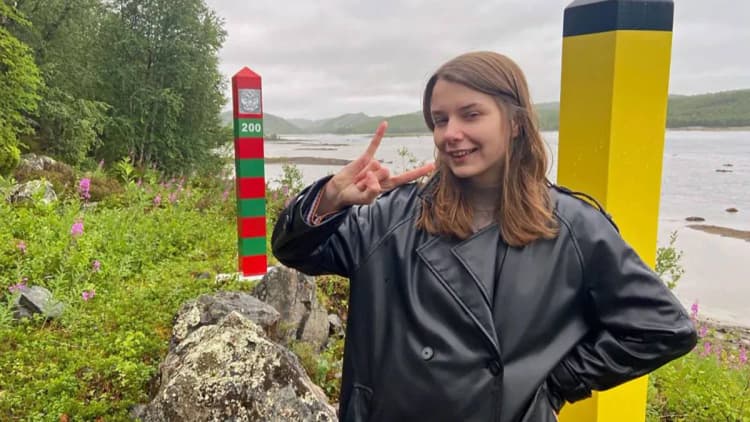
Olesya Krivtsova is a student and journalist who studied in the northern Russian city of Arkhangelsk until police came to her apartment with a search warrant. Anti-war statements on social media led to two criminal cases being opened against her under Russia’s infamous laws on “discrediting of the Russian army” and “justifying terrorism.” While under investigation, Olesya was placed under house arrest, but in the spring of 2023, wearing an electronic ankle bracelet, she managed to leave the country. Now she’s living in the north again—but this time in safety and relative comfort in Kirkenes, Norway, near the Russian border. Olesya works at what’s known as “the northernmost independent Russian-English media outlet in Europe” — The Barents Observer, which focuses on the region spanning both sides of the Russia-Norway border. The Freedom Degree helped Olesya gain admission to European Humanities University in Lithuania.
Education in Russia
– In 2021, I started studying at a university in Arkhangelsk. Back then, I didn’t really think much about what I wanted to study or do. I felt like I hadn’t fully lived out my youth, and I wanted to have fun more than go to university. I really wanted to take a gap year after high school, but it didn’t work out. I studied ‘advertising and PR’ for a year and a half, although I was more interested in journalism and history. I even tried to transfer at some point, but it didn’t happen. The history faculty appealed to me partly because my husband is a historian, and partly because it was known for having a lot of neo-Nazis — I thought it wouldn’t hurt to bring a bit of leftist energy there. I was never really into advertising or PR as a profession, and I lost interest in the program pretty quickly. Then came the criminal case.
Olesya says her attitude toward education changed while she was under house arrest.
– I realized how much I wanted to study — not at my university in Arkhangelsk, but just in general. I wanted to be a free student.
It was during this time that she was contacted by Freedom Degree, and her thoughts about studying abroad began to take on more concrete form.
Rescue in Europe
After escaping Russia in March 2023, Olesya ended up in Lithuania and began the process of applying to university.
— I got another message from a representative of Freedom Degree and realized I now had to settle down in Europe and start doing something. But I was in a really anxious state, I was very shaken by everything that was happening. I was worried about my mom and my husband, who had stayed in Russia. It was my first time abroad, and despite everything, yes, I understood that I had to live here now and figure things out. But mentally I just wasn’t there — I was deeply anxious about literally everything.
In addition to financial support, Olesya received assistance from our project in two other aspects. The first was preparation for the interview. Olesya worked with a Freedom Degree coordinator, who helped her prepare for the interview and explained how it would proceed. In addition, she did not have a school diploma, which was a problem for admission. Olesya's former university in Arkhangelsk came up with various formal excuses not to return her school certificate to Olesya's official representative. FD took over all communication with EHU in Vilnius and managed to resolve the issue with the documents.
The university in Russia required me to provide a power of attorney for the person who would collect my diploma. This was not possible. I cannot issue a power of attorney because I do not have Russian documents, I am not entitled to obtain them, and I cannot go to the Russian embassy for consular services.
Olesya began preparing to apply for a bachelor’s program and improving her English when she received an unexpected job offer in northern Norway at The Barents Observer. Initially, her plan had been to study full-time, but she had to adjust it because work and financial stability took priority. Thus it happened that she now lives and works in one European country while studying in another.
Studying at EHU and balancing work
Olesya tells us that she enjoys studying, though at first it was difficult to balance a full-time job with university.
— Lectures would often happen during work hours, and I couldn’t keep up with everything. But over time I adapted, and now I’m getting 9s and 10s [the highest grades — ed.].
She is enrolled in a five-year part-time program, and she says being outside of Lithuania is not a problem.
— We have a lot of different courses. I like the media production course — we learn video editing, filming, lighting, and working with equipment. There was a course on journalism basics. Right now we have one called ‘effective communication,’ that’s what it’s called. We also have a year of English. I really liked the journalism course — there’s a theory part on things such as ethics, and a practical part on text editing. I enjoyed it because I was able to complement my hands-on work with theory. There’s also a course on media research methodology where we engage with academic media research.
Olesya highlights the hands-on nature of the classes and appreciates that students in Vilnius have access to a professional studio.
— I like that you can learn the full process of video production — the basics of filming and editing.
Life in Norway
Olesya’s situation is unusual in that she lives and studies in different countries, and she really enjoys living in Norway.
— There’s great access to healthcare services here. I can see a doctor regularly, I don’t have to pay for insurance — in that sense, Norway is different in a really good way. You don’t have to wait months to see a specialist if you’re in pain or really need help. That even applies to dental care. I’ll soon be having jaw surgery to fix my bite — it’s all completely free.
Olesya recalls other positive aspects of life in Norway: labor rights (including a year of paid parental leave) and five weeks of guaranteed vacation.
— Even with my migration status, I have access to all these services.
Norwegian democracy, she says, tolerates Russian pro-government events. She recently reported on a Victory Day celebration in her town. Local Russian-speaking residents brought Wagner PMC flags, St. George’s ribbons (banned in some European countries), and openly linked the Victory Day to the current war in Ukraine.
— In Norway, they’ll tolerate even Nazi marches with swastikas. As long as you don’t start a fight or break the peace, no one will touch you.
Challenges and future plans
— There’s not much time for myself, almost no free time. I’m 22 and I still haven’t had a typical student life — no parties, none of that. We live in a small town, I live with my husband, but we don’t have much in-person social life. That’s hard too. I want to be more social.
Olesya’s mother and sister have also moved to Norway. Like many in her position, Olesya finds it hard to make long-term plans while in migration. She’s not sure whether she’ll go on to do a Master’s degree, mostly because she doesn’t want to go through the stress of combining full-time work and study again. The media outlet where she works was recently declared an “undesirable organization” in Russia, which has made it much harder to find sources and interviewees.
— In general, I want to keep working as a journalist, to grow, read more, write more, and do meaningful work.
At the same time, Olesya isn't worried about the idea of having to learn new skills in related fields.
— Maybe if I get good at it, I could work as a videographer. I’m the kind of person who could work lots of different jobs. I’d even be fine working in a kindergarten or someplace completely unrelated to what I do now.
As for Russia’s future, Olesya doesn’t see a clear or optimistic path.
— I’m not going to study in Russia. Most likely, I’m not going back. First of all, we don’t even know what’ll happen there tomorrow or the day after. In a few years, I’ll be able to get a Norwegian passport. I’m getting settled here. Going back to Russia, even in the best-case scenario, would be a second emigration for me. I’ve really, really grown to love Norway.
Of course, I wish there were more opportunities to keep doing journalism normally and without repressive restrictions. Maybe someday in the future I could work as a journalist in Russia, if things change.

Find opportunities that are right for you to continue your education outside your home country.
Connect With Us
© 2025 Freedom Degree
Freedom Degree, Inc. is a 501(c)(3) nonprofit organization. © 2025 | Powered by Strapi